Product Development / Published Research · 2024
Agricultural Utility Vehicle
A compact, multipurpose agro-farm vehicle designed as a lower-cost alternative for small-scale farmers.
- Duration
- Aug 2023 – May 2024
- Role
- Design Contributor
Overview
Project Overview
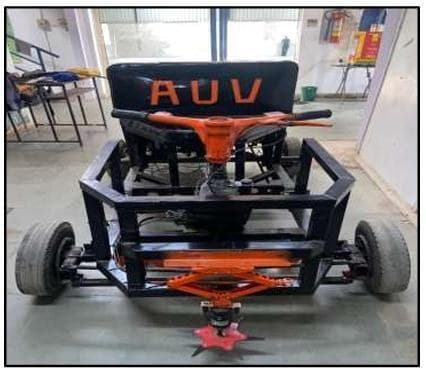
Small-scale farmers often cannot afford the multiple specialized machines that mechanized agriculture typically requires, which raises operating costs and limits productivity. This project set out to develop a compact, multipurpose agricultural vehicle — combining a cutter, cultivator, row maker, and auger on a single chassis — as a lower-cost alternative built around a repurposed scrap engine and cost-effective components.
The Problem
Engineering Challenge
The objective was to replace several specialized machines with one affordable, multi-function platform without sacrificing the core operations small farms rely on.
- High cost of individual specialized agricultural machines
- Limited mechanization access for small-scale farmers (average landholding around two acres)
- Need to combine cutting, cultivating, and row-making functions on one chassis
- Requirement to keep the design serviceable by local mechanics in rural areas
Root Cause
Problem Investigation
The team conducted market surveys of existing tractors and mini agricultural vehicles, reviewed prior literature on multipurpose farm machinery, and ran a structured problem-identification phase before sketching concepts.
What It Had to Do
Design Requirements
How It Was Built
Design & Development Process
Literature Review
Reviewed prior research on multipurpose agricultural machinery, fertilizer distributors, seed-sowing equipment, and small tracked vehicles to ground the design in existing work.
Requirement Analysis
Ran market surveys and problem identification to define the operations the vehicle needed to perform.
Concept Development
Produced rough diagrams of the cultivator, cutter, and row maker, then a conceptual solid model combining all three onto one chassis.
CAD
Modeled the full assembly and selected materials — structural square pipe, angled GI pipe, and metal sheet — based on market pricing and availability.
Prototype
Fabricated the vehicle from a scrap rickshaw base, building the front extended body, steering assembly, cutter assembly, and cultivator shaft.
Evaluation
Tested the cultivator under load, identified a shaft-twisting failure from overloading and low-grade bearings, and resolved it with a solid shaft and upgraded bushed bearings.
CAD Development
Design in SolidWorks
Prototype
Physical Validation
Final Implementation
Result
Published Research
Publication
International Research Journal of Engineering and Technology (IRJET)
Volume 11, Issue 10 (Oct 2024)
Abstract
India's agricultural sector supports nearly 58% of the population, yet many farmers still rely on traditional, labor-intensive methods due to the cost of modern machinery. This paper presents the design and development of a compact, multipurpose agricultural vehicle combining a cutter, cultivator, and row maker on a single chassis, built around a repurposed engine and cost-effective components. The resulting vehicle targets a 35–40% cost reduction versus comparable dedicated machines, aiming to make mechanization accessible to small-scale farmers while remaining serviceable by local mechanics.
Download PaperImpact
Results
Reflection
Lessons Learned
Grounding the concept in a structured literature review surfaced design decisions — like chassis material and row-spacing mechanisms — that would have taken far longer to arrive at through trial and error alone.
The cultivator shaft failure during testing was a direct lesson in matching bearing grade and shaft design to actual working loads, not just nominal ones.
Designing around a repurposed scrap-vehicle base and market-priced raw materials kept the project's cost target realistic for the audience it was meant to serve.
Technology Used
Skills Applied
Keep Exploring