Published Work
Research & Publications
International Research Journal of Engineering and Technology (IRJET)
Volume 11, Issue 10 (Oct 2024)
Agricultural Utility Vehicle
Abstract
India's agricultural sector supports nearly 58% of the population, yet many farmers still rely on traditional, labor-intensive methods due to the cost of modern machinery. This paper presents the design and development of a compact, multipurpose agricultural vehicle combining a cutter, cultivator, and row maker on a single chassis, built around a repurposed engine and cost-effective components. The resulting vehicle targets a 35–40% cost reduction versus comparable dedicated machines, aiming to make mechanization accessible to small-scale farmers while remaining serviceable by local mechanics.
Motivation
The objective was to replace several specialized machines with one affordable, multi-function platform without sacrificing the core operations small farms rely on. Small-scale farmers often cannot afford multiple specialized machines, which raises operating costs and limits productivity — the project set out to combine several field operations onto one affordable platform.
Methodology
- Literature Review: Reviewed prior research on multipurpose agricultural machinery, fertilizer distributors, seed-sowing equipment, and small tracked vehicles to ground the design in existing work.
- Requirement Analysis: Ran market surveys and problem identification to define the operations the vehicle needed to perform.
- Concept Development: Produced rough diagrams of the cultivator, cutter, and row maker, then a conceptual solid model combining all three onto one chassis.
- CAD: Modeled the full assembly and selected materials — structural square pipe, angled GI pipe, and metal sheet — based on market pricing and availability.
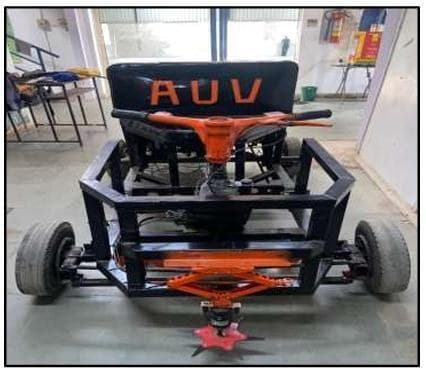
- Prototype: Fabricated the vehicle from a scrap rickshaw base, building the front extended body, steering assembly, cutter assembly, and cultivator shaft.
- Evaluation: Tested the cultivator under load, identified a shaft-twisting failure from overloading and low-grade bearings, and resolved it with a solid shaft and upgraded bushed bearings.